

Feng Shui Front Door: 19 Considerations with Tips, & Cures


Front door is the first thing people notice while entering your home, it is like the first impression of the home people are about to enter. Do you feel it is important to look into the feng shui of front door?
I noticed that when people talk about the feng shui of the front door, they mostly talk about the door’s color, the direction it is facing, and whether that area is filled with clutter.
However, those are just a few of many considerations, and you will soon discover that determining whether the front door brings good feng shui is not a simple feat.
In this post, you will see 19factors that’ll help you determine how good your front door’s feng shui is, along with tips and cures from experts and personal experience.
Why is the Front Door So Significant in House Feng Shui?
If you haven’t noticed, feng shui places heavy emphasis on the front door.
But why is that? Here is an explanation by Sophie Keller that I really liked:
Think of the front door as the mouth of the house. It is where the house gets its intake of energy, whether they be good or bad. Having good energy coming through the front door is similar to a person eating healthy. The occupants of the house will be happily enjoying a comfortable home that’s full of positive energy.
In a more practical sense, the front door frames your first sight as you leave and enter the house. It works a little like first impression, and it impacts the mentality, mood, and attitude on how you start the day and how you feel when you get home.
With that said, let us see the 19 factors have the ability to affect our mentality and energy intake of the house.
The Front Door Ideas
1. Size
The size of the front door should be proportionate to the house. You wouldn’t want a small door to a mansion or a large door to a tiny hut. It wouldn’t feel right, would it? Feng shui warns that disproportionate door sizes may cause problems with wealth and career.

The front door must also be larger than other doors inside the house. Though most houses today do not have this problem, I have seen master bedroom doors that are larger than front doors. When this happens, feng shui warns of problems with relationships, marriage, and emotional control.
The cure is to get a more proportionate-sized door. Though it sounds simple, it’ll require some investment on your part.
2. Color
There’s much about the color of the front door. However, type of color you need varies according to many factors like the direction it’s facing. size of the house, color tone of the house, the person’s Kua determined by the birth year, and the location it’s located in the house.

Generally, most experts agree that the color should be more inviting and should easily catch the attention of the eye. Most importantly, it should also be a color that you like and are comfortable looking at every single day.
3. Material
The materials of most doors are usually metal, wood, or fiberglass. Even though you can choose either metal or wooden doors to balance the five elements of that area, I wouldn’t do it if the material is not within your taste. In other words, I wouldn’t sacrifice personal preferences over the choice of materials.
In addition to personal taste, the door should make you feel safe and protected. For instance, I’ve seen many apartments that add metal layers for added security.

Whichever material you choose, make sure that the door is aesthetically appealing and makes you feel safe.
4. Maintenance
Your door should be properly maintained because it is the first experience you have with the house. Here are some questions to tell if your front door is properly maintained: Does it open and close easily? Does it make any squeaky sound when you use it? Is it rusty? Are the paints falling off?

A poorly maintained door can take away all the positive energy in you as you enter the house. It is likely that as you enter that door, you’re thinking of all the problems that requires attention within the house. In short, it will dampen your mood.
Other times, going home may become a drag. You may feel like you’d rather stay out rather than going home. If you invite guests over, how do you think they would feel when they’re waiting right in front of your doorsteps, staring at a run-down door?
Location & Direction
5. Direction It’s Facing
Whether the front door is facing your lucky direction is determined by your Kua number using the Eight Mansions formula. To give you a brief summary, there are four lucky and unlucky directions for each individual, and your front door should face one of your lucky direction. You can find your Kua number using the calculator provided by Kathryn Weber.
If the direction it’s facing is not a lucky direction, you can look into the five elements of the front door which is also determined by the direction it’s facing. If the five element is a match with you, you need not worry too much even if the front door is facing an unlucky direction. On a side note, the direction it’s facing can also help determine where the wealth location of your house is.
If you’d like to learn more about this, I have provided much detail of this method in my Feng Shui eBook as well as a case study on how it affected an individual’s life.
6. Where It’s Located in the House
Again, you will need your Kua number to determine whether the front door is located at a lucky area of the house. If it is not, you will need to use the five elements to determine how compatible your element is to the front door’s five elements. This method is similar to the one mentioned above, which I’ve outlined in detail in this eBook.
Another consideration about the location is whether the front door is easy to find.

The front door should be easily located by guests that are visiting the house and should never be at the back of the house (I’ve seen those) or on the side.
7. Opens Inward/Outward
Does your front door open inward or outward?
If you haven’t noticed, most front doors open inwards where you or your guests can easily enter the house once the door opens. Conversely, for front doors that open outward, you and your guests may have to take a few steps back before entering the house.
Although this is a small detail, it gives a subtle feeling of how the house welcomes you.

Outside the Door
8. Avoid Poison Arrow
The most common type of “poison arrow” is a T-intersection that’s facing the house. Other types of poison arrow include a long alley that directly leads to the front door.

How much problems the poison arrow brings depend on many factors, such as whether the house is elevated compared to the road, the length of the front yard, and whether there are trees or other types of obstructions. Also, as I’ve mentioned before, not all T-junctions are bad feng shui.
Some experts suggest hanging a bagua mirror in the front door, but a more practical method is to plant bushes or trees to protect your property from the incoming traffic.
9. Avoid Sharp and Pointy Objects
This is part of the Form School of Feng Shui, where sharp objects are despised because it brings negative Qi that makes us uncomfortable. These objects are usually shaped in triangles or long pointy objects, which include electric poles, triangular roofs, and stop signs.
To understand why it brings negative Qi, I often like to ask people this question: Imagine if you have a knife pointed at straight at you without anyone holding it, how would you feel?
How much these objects impact the feng shui of the front door depends on the size of the object and its distance from you. Some experts suggest that hanging a mirror in the front door is able to remedy this effect. Perhaps the reflection cancels out each other?
10. Avoid Corners of Buildings
This is also part of the Form School of Feng Shui and similar to the sharp and pointy objects as mentioned above.
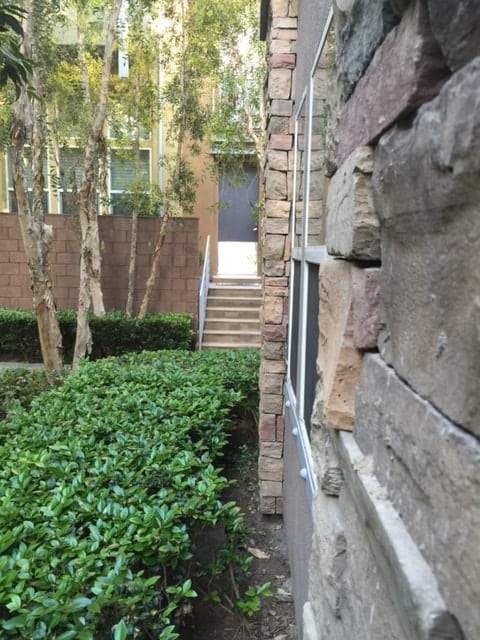
Corners can make us feel uneasy because they have the ability to hurt us physically. The type of feeling is similar to when you’re sitting at the corner of a square or rectangular table for a long period of time. Your could’ve been more comfortable sitting somewhere else, correct?
Some experts suggest hanging a bagua mirror on top of the front door as remedy. Others have suggested placing a pair of stone lions in front of the door if the building is too big and its distance too close. I personally have no experience on how well these remedies work.

11. Soften the Path to the Front Door
The path to the front door should create a soothing and inviting feeling.
Some experts, especially the Western feng shui practitioners, suggest that the path leading to the front door should be curved instead of straight. This is because curved roads resemble roads made of nature, and it’ll help brighten our mood because of our innately strong connection to nature.
The type of plants on the side of the walkway also plays a big role. To improve the experience of you and your guests when entering your home, plant flowers alongside the walkway because it will provide a peaceful and comforting feeling.
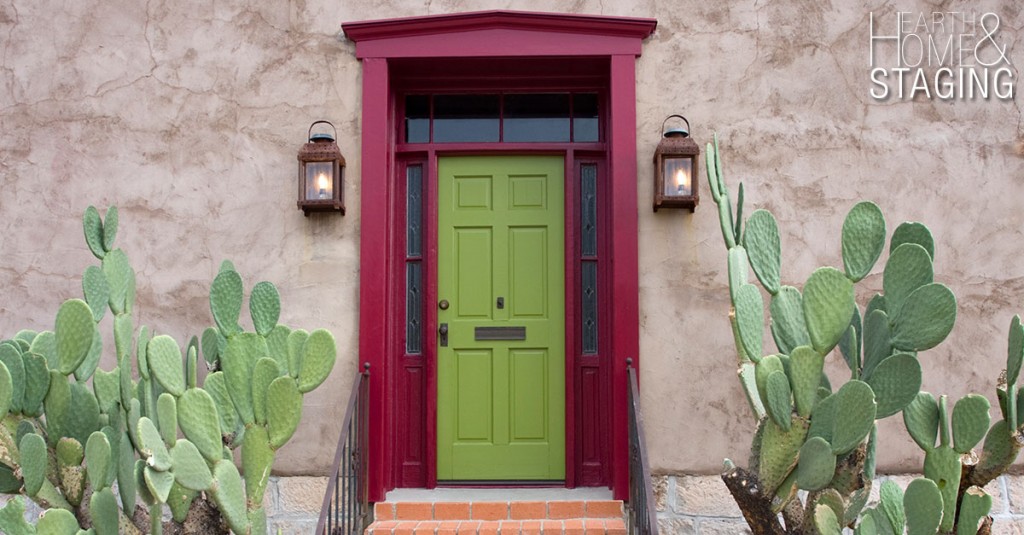
Avoid using cacti because, like any other sharp objects, they raise our survival instincts and can physically harm us.
12. Reduce Clutter and Obstructions
How would you feel if your front door is filled with clutter? Seeing and moving through clutter every day when you enter and exit the house can cause frustration and fatigue. Some of you may even feel stressed because it adds one more thing to your to-do list, and one day you might just feel overwhelmed and get overly emotional.

The solution is quite simple – just keep the front door area clean and organized.
Other more common obstructions include a tree straight from the front door, as well as electric and telephone poles like those mentioned earlier. As long as it is not too close to your home, or if you have a boundary wall or bushes in between, you are in good shape.
Inside the Front Door
13. Keep an Open Space
The area inside the house should have an open space and clutter free. This area is what’s called the “bright hall”, which applies to both the inside and outside area of the front door.

The “bright hall” is where the Qi is said to gather, so it is best to keep the place clean and organized. The size of this area should also be proportionate to the size of the house. Placing a screen room divider or using a different set of tile colors can help define the size of this area.
14. Directly Facing Stairs
Some feng shui experts warn that if a stairway faces the front door, you will experience many ups and downs in your life. Others claim that money will roll down the stairway and straight out of the door.

A better explanation is that your attention will naturally be drawn to the stairway. Because the second floor is usually private bedrooms, you or your guests will feel awkward because you may feel as if you are invading other people’s privacy. In other words, if you’re a guest, how comfortable would you be to visit the bedroom of the host on a first visit?
There’s no best remedy for this situation. However, one thing you can do is to direct the attention away from the stairs. Using carpets that mimic a road that leads to the living room area is one way to do it.
15. Faces Kitchen Stove
Some experts believe that if you can see the kitchen stove right when you enter the house, the occupants of the house will have problems with expenses and troubles with saving money.
Other claims that if the kitchen is facing the front door, any positive Qi entering the house will be demolished by the fire and cooking activities in the kitchen.
There’s no ideal cure for this unless you undergo major renovation such as building a wall or relocating the door or kitchen. However, you can try to place a screen room divider if you have the proper setting so the incoming Qi from the front door is redirected to other areas.
16. Leads to Toilet
This is just awkward. Instead of being greeted by a warm and welcoming living room, the first thing you see is the toilet.
Similar to kitchen, experts claim that the Qi entering from the front door will escape through the bathroom or be polluted by the negative Qi of the restroom.
Again, you can put a screen room divider if space allows, which will help redirect human traffic and incoming Qi. Other methods include improving the feng shui of the bathroom or by keeping the bathroom door closed.
17. Leads to Doors of Other Rooms
The problem with seeing the doors to other rooms is similar to seeing the stairway – your attention will be drawn to that room. Not only will the occupants of that room feel that their privacy is constantly under threat, guests will feel awkward and uncomfortable because they might feel intrusive.
The solution is to add heavy furniture, such as tall book shelves, in between the two doors to serve as a wall if space allows. Though a screen door divider can improve the experience of guests, it may not be enough to improve the comfort of living in that room.
18. Aligns with Backdoor
Many feng shui experts warn that if the front door aligns with the backdoor, all the energy that flows from the front door will go straight out of the backdoor. Some interpret this to mean that money will fly right out the back.
Other explanations include that you will be naturally drawn to the back of the home and you won’t be appreciating the other areas of the home.

The cure for this is to add furniture in between. These can range from sofas, fish tanks, book shelves, and a screen room divider.
19. Running into a Mirror
Placing a mirror on the opposite wall of the front door is said to cause the energy to bounce around relentlessly, which may bring unsettling disturbances in the family. Others have said that the mirror can push all the fortune out of your home.
Our eyes are embedded with motion detectors, and any unexpected movements in a mirror will alarm us. If a mirror is right in front of you when you enter the home, you may feel as if someone is walking towards you and startle yourself. It is just bad experience.
We have a whole article on how to place mirrors in the house that you can refer to.
Garage Door vs. Front Door
Today, many of us use the garage door more frequently than the front door (like me). If that’s the case, the front door feng shui should have little effect on you. And even if you have superb front door feng shui, all the good energy that you’re supposed to reap the benefits from will practically be non-existent.
This is because, as some experts suggest, that the person entering the house brings the outside Qi inside. Likewise, the person living in the house will bring the energy from within the house to the outside.
This is why simply opening the door and letting the air inside wouldn’t work, because the energy has to interact with humans. This is also why it’s called the “front door” in the first place. It is the main door that people use to enter and leave the house.
Conclusion
Determining the feng shui of the front door is not a simple task, and none of the 19 considerations mentioned above are definite or absolute because one factor can greatly outweigh the other if the conditions are right.
In other words, not a single one of the considerations mentioned above can make or break the feng shui of your front door. For instance, sometimes obstructions in the front door can help remedy the effects brought by a T-intersection.
If you are serious about improving the feng shui of your front door and of your house, I suggest that you hire a professional rather than do it yourself. Here’s what you should do to get the most out of a feng shui consultation, if you decide to get one.
 Like
0
Like
0
 Dislike
0
Dislike
0
 Love
0
Love
0
 Funny
0
Funny
0
 Wow
0
Wow
0
 Sad
0
Sad
0
 Angry
0
Angry
0






Comments (0)